The Banker Bet Illusion: When Conventional Wisdom Becomes a Liability at the Baccarat Table
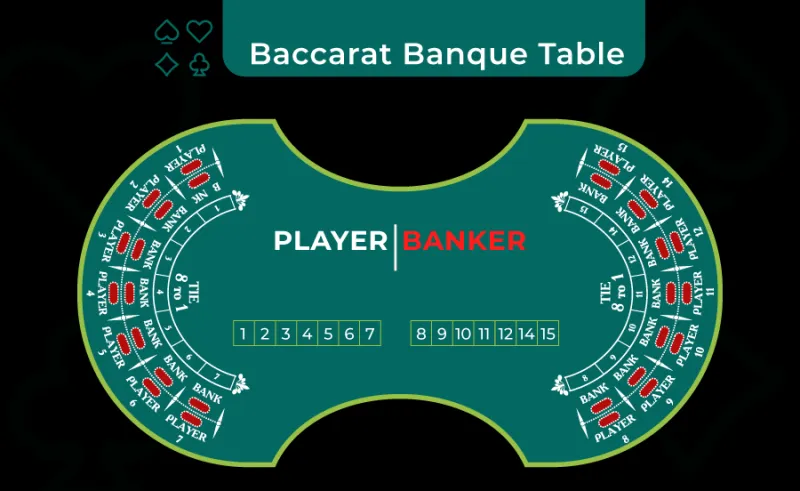
Photo: baccarat table chips cards banker player bet casino strategy, via chipy.com
Few pieces of baccarat advice circulate more freely than this one: bet the banker. It appears in strategy guides, forum threads, and casual casino conversation with the confidence of settled science. The banker bet, the argument goes, carries a lower house edge than the player bet and is therefore the rational choice for anyone who takes the game seriously.
This is not entirely wrong. But it is substantially incomplete. And for American players who build entire session strategies around banker-heavy wagering, that incompleteness can be expensive.
This analysis examines what the conventional wisdom gets right, where it misleads, and how a more nuanced understanding of banker bet risk can materially improve your approach at the table.
The Mathematics Behind the Reputation
The banker bet's favorable reputation is grounded in legitimate probability. In a standard eight-deck baccarat game — the format most commonly encountered at American casinos and live-dealer platforms — the banker hand wins approximately 45.86% of decisions, the player hand wins approximately 44.62%, and ties account for roughly 9.51%. When ties are excluded, the banker wins approximately 50.68% of resolved hands.
This edge is real. It produces a house advantage of approximately 1.06% on the banker bet, compared to 1.24% on the player bet, after accounting for the standard 5% commission applied to winning banker wagers. On a purely theoretical basis, across an infinite number of hands, the banker bet is mathematically superior.
The problem is that American players do not play infinite sessions. They play finite ones — often two to four hours in a casino, or a defined number of hands on a live-dealer platform. And within those finite sessions, the gap between theoretical expectation and actual variance can be significant enough to render the banker bet's mathematical edge nearly irrelevant.
Commission Structures and the Hidden Cost of Consistency
The 5% commission on winning banker bets is a well-understood feature of the game, but its cumulative effect on session profitability is frequently underestimated. Consider a player wagering $100 per hand, exclusively on the banker, across a 60-hand session. If the banker wins at its expected rate of approximately 50.68% of resolved hands — roughly 27 of those 53 non-tie decisions — the gross return looks acceptable. But after commission, the net return on those 27 wins is reduced to $95 each, while all losses are absorbed at full value.
Over a full session, this commission drag is not trivial. It compounds across every winning hand and creates a structural disadvantage that the banker's raw win rate must consistently overcome just to break even. In sessions where the banker win rate underperforms its expectation — which occurs with meaningful regularity — the commission structure accelerates losses rather than cushioning them.
Some American casinos and live-dealer platforms offer commission-free baccarat variants, typically by paying even money on banker wins except when the banker wins with a total of six, which pays at reduced odds. These formats alter the risk calculus considerably and deserve separate analysis before a player commits to a banker-heavy approach.
Variance, Streaks, and the Short-Run Reality
Probability modeling of baccarat sessions reveals a pattern that surprises many players: the banker bet, while superior in expected value, does not produce meaningfully lower session variance than the player bet. The difference in win rates between the two wagers — roughly 1.06 percentage points on resolved hands — is too narrow to produce statistically distinct variance profiles across typical session lengths.
In practical terms, this means that a player who bets exclusively on the banker will experience losing streaks of comparable length and frequency to a player who bets exclusively on the player. The mathematical edge of the banker bet does not translate into session stability. It translates into a marginally better long-run outcome — one that only fully materializes across thousands of hands.
For the American recreational player whose annual baccarat volume is measured in hundreds of hands rather than tens of thousands, the banker bet's theoretical edge may never manifest in actual results. What will manifest, consistently, is session variance — the natural swings of a near-coin-flip game that the banker's modest edge cannot meaningfully suppress.
When Banker-Heavy Betting Increases Volatility
There are specific session contexts in which an exclusively banker-oriented betting strategy can actively increase volatility and accelerate bankroll erosion.
During player-dominant shoes: Baccarat shoes do not distribute wins evenly between banker and player in every instance. Some shoes run heavily toward player outcomes — a statistical reality, not an anomaly. A player rigidly committed to banker betting during such a shoe will absorb extended losing sequences while a more flexible approach might have preserved capital.
In high-unit sessions with aggressive progression systems: Players who combine banker-only betting with positive progression systems — increasing unit size after wins — create compounding exposure during the inevitable regression to mean. The commission on each winning step of the progression quietly erodes the gains that trigger the next increase.
In late-shoe play with reduced deck penetration: As a shoe approaches its conclusion, remaining deck composition can create short-term probability environments that deviate meaningfully from the shoe's overall averages. Rigid banker betting in these phases ignores available information in favor of a statistical generalization.
A More Sophisticated Framework
The appropriate response to this analysis is not to abandon the banker bet. Its mathematical properties are genuine and should inform your default positioning. The appropriate response is to treat it as a contextual tool rather than an unconditional strategy.
Consider the following adjustments to a banker-centric approach:
Establish session-specific banker thresholds. Define in advance the conditions under which you will shift away from banker wagering — a defined number of consecutive banker losses, for example, or a shoe that has demonstrated sustained player dominance through its first third.
Account for commission in your unit sizing. When calculating your session bankroll requirements, factor the 5% commission into your expected loss calculations rather than treating gross win rates as your baseline.
Treat the player bet as a legitimate strategic option. The player bet's house edge of 1.24% is not dramatically higher than the banker's 1.06%. In specific session contexts — particularly when flexibility preserves capital during player-dominant stretches — the player bet earns its place in a complete strategic toolkit.
Evaluate commission structures before you sit. Not all American baccarat tables apply the same commission terms. Understanding the specific variant you are playing before committing to a betting approach is a basic due diligence step that many players skip.
Rethinking What 'Safe' Actually Means
In baccarat, as in most forms of structured risk-taking, safety is contextual. The banker bet is the statistically preferable wager across a sufficient sample of hands. It is not, however, a hedge against session variance, a protection against unfavorable shoe dynamics, or a substitute for disciplined bankroll management.
At Baccarat 1688, we hold that genuine strategic sophistication begins where conventional wisdom ends. The banker bet deserves its reputation — and it also deserves your critical scrutiny. Understanding both dimensions of that wager is what separates players who survive and thrive across sessions from those who follow received advice straight into avoidable losses.