Odds Fluency: How Converting Between Global Betting Formats Exposes Hidden Value at the Baccarat Table
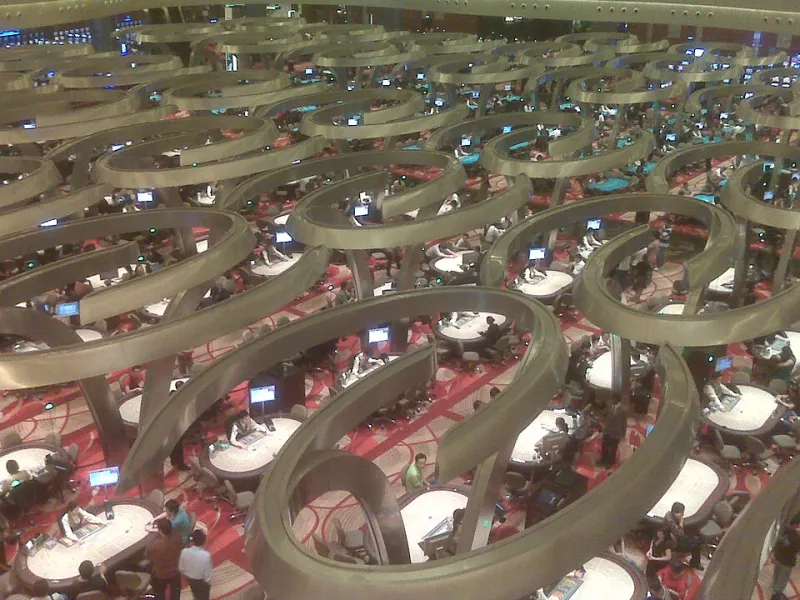
Photo: hj_west from USA., CC BY-SA 2.0, via Wikimedia Commons
The Number Language Nobody Taught You at the Casino
Walk into any major Las Vegas casino or log into a reputable online baccarat platform and you will encounter the game presented in its most familiar American packaging: clear bet boxes, a Banker commission of five percent, and payouts expressed in straightforward ratios. What you will not see posted on the felt is the underlying mathematical reality that sportsbook-savvy gamblers carry in their heads at all times — a fluency in multiple odds formats that quietly reshapes how every single bet is evaluated.
The United States gambling market is overwhelmingly moneyline-centric. American bettors are conditioned to think in plus and minus figures: a –110 line means you risk $110 to profit $100, while a +150 line means a $100 wager returns $150 in profit. That framework is intuitive for football and basketball, but it creates a subtle blind spot when those same bettors sit down at a baccarat table. The card game does not advertise its odds in moneyline notation, yet the underlying mathematics are every bit as convertible — and every bit as revealing.
A Primer on the Three Major Formats
Before examining how this knowledge applies specifically to baccarat, it is worth establishing the conversion mechanics clearly.
American Moneyline expresses odds relative to a $100 unit. A negative number indicates the amount you must wager to win $100; a positive number indicates what a $100 wager wins.
Decimal Odds, the dominant format across Europe, Australia, and most internationally licensed online platforms, represent the total return per unit staked — including the original stake. A decimal odd of 1.95 means a $1 bet returns $1.95 total, yielding a $0.95 profit.
Fractional Odds, the traditional British format still common in horse racing contexts, express profit relative to stake. A 19/20 fractional odd means you profit $19 for every $20 wagered.
The conversion between these three is mechanical and precise:
- To convert a positive moneyline (+150) to decimal: divide by 100, then add 1. Result: 2.50.
- To convert a negative moneyline (–110) to decimal: divide 100 by the absolute value, then add 1. Result: approximately 1.909.
- To convert decimal to fractional: subtract 1 from the decimal figure, then express as a fraction. A decimal of 1.95 becomes 19/20.
None of this is complicated arithmetic. What makes it powerful is the discipline of applying it consistently to every bet you consider.
Applying the Lens to Baccarat's Core Bets
Consider the three primary baccarat wagers through this framework.
The Player bet pays even money — a 1:1 ratio. In decimal terms, that is 2.00. In moneyline notation, that is +100. The house edge on this bet sits at approximately 1.24 percent, meaning the fair decimal odds for a break-even Player bet would be approximately 2.025. The casino posts 2.00. The gap between 2.025 and 2.00 is the house's margin, expressed with precision.
The Banker bet pays 0.95:1 after the five percent commission. In decimal terms, that is 1.95. In moneyline terms, that is approximately –105. The Banker wins more frequently than the Player — roughly 45.86 percent of decisions excluding ties — which is why the commission exists. The fair decimal price for the Banker bet, accounting for its higher win rate, would be approximately 1.9806. The casino posts 1.95. Again, the gap is the house edge, now approximately 1.06 percent.
The Tie bet pays 8:1, or 9.00 in decimal format. The actual probability of a tie occurring is roughly 9.52 percent, implying a fair decimal price of approximately 10.50. The casino posts 9.00. That gap — between 10.50 and 9.00 — represents a house edge exceeding 14 percent. Expressed in these terms, the Tie bet's poor value becomes viscerally apparent in a way that the simple label "8 to 1" often obscures.
Where Sportsbook Discipline Enters the Picture
Professional sports bettors operate under a strict rule: never place a wager without first converting the offered odds into an implied probability and then comparing that probability against your own estimated true probability. If the market's implied probability is lower than your estimated true probability, you have identified positive expected value. If it is higher, you are paying a premium that erodes your bankroll over time.
Baccarat players who internalize this discipline approach the table differently. They are not chasing patterns on a scoreboard or riding intuition about which side is "due." They are evaluating each bet as a discrete pricing question: what is the casino offering, what is the mathematically fair price, and what is the gap between the two?
This practice is particularly valuable when comparing baccarat offerings across different online platforms. Not every licensed operator charges the same Banker commission. Some platforms offer a reduced commission of four percent or even a commission-free structure that pays even money on Banker wins but pushes on a Banker total of six. In decimal terms, the standard 1.95 Banker payout versus a commission-free 2.00 payout represents a meaningful shift in expected value over hundreds of decisions. The player who can calculate this gap in real time — and select platforms accordingly — is exercising genuine edge selection, the same skill that separates disciplined sports bettors from casual ones.
The Compounding Effect of Numerical Literacy
It would be a mistake to frame this discussion as a search for dramatic arbitrage windfalls. Baccarat does not offer the kind of mispricing that occasionally surfaces in sports betting markets. What it does offer is a structured environment where every percentage point of house edge reduction accumulates meaningfully across a serious player's career.
Consider a player who makes 500 Banker bets per month at $25 each. That represents $12,500 in monthly action. The difference between a 1.06 percent house edge and a 1.24 percent house edge — the gap between the Banker bet and the Player bet — amounts to approximately $22.50 per month in expected value. Over a year, that is $270. Over five years, $1,350. These figures assume no other strategic adjustments; they reflect only the discipline of consistently selecting the marginally superior bet.
Now layer in the additional discipline of platform selection — choosing operators with reduced commission structures — and the compounding effect becomes more substantial still.
Building the Habit
The practical recommendation for any serious American baccarat player is straightforward: before your next session, practice converting the game's standard payouts into all three odds formats until the process is automatic. Carry that mental framework to every table you visit, whether live or online.
When you encounter a side bet advertising a 25:1 payout, convert it immediately. What is the decimal equivalent? What implied probability does that represent? What is the actual probability of that outcome occurring? The gap between those two probabilities is the price you are being asked to pay. Sometimes it is acceptable. Often it is not.
At Baccarat 1688, the guiding principle is that informed play is disciplined play. Odds fluency is not an exotic skill reserved for professional gamblers. It is a basic numerical literacy that any committed player can develop — and one that pays dividends at every table, on every session, for as long as you choose to play.